Inbound vs Outbound Call Center: Which Is Better
Neither is universally better — Inbound vs Outbound Call Centers serve fundamentally different business objectives. Inbound Call Centers receive customer-initiated contacts and are best for support, retention, and relationship management. Outbound Call Centers initiate contact with customers and are best for sales, lead generation, and proactive engagement. Most businesses need both. Modern Inbound vs Outbound Call Center Services from DialDesk integrate AI into each model, maximising effectiveness regardless of which direction the call travels.
Inbound vs Outbound Call Centers: The Core Definition
Inbound vs Outbound Call Centers
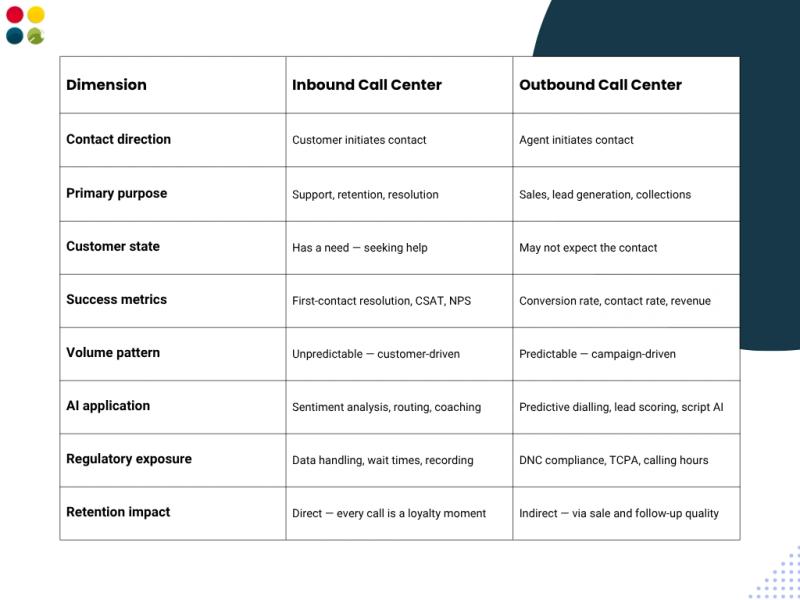
Inbound Call Center: A contact center operation that receives customer-initiated contacts — calls, chats, WhatsApp messages, and resolves them. The customer drives the timing, channel, and reason for contact. Metrics focus on resolution quality, first-contact resolution rate, and Customer Experience.
Outbound Call Center: A contact center operation where agents initiate contact with customers or prospects, for sales, collections, surveys, or follow-up. The business drives the timing and agenda. Metrics focus on conversion rate, contact rate, and revenue per call. Inbound vs Outbound Call Center Services are not competing alternatives. They are complementary models that address different stages of the customer lifecycle.
Inbound vs Outbound Call Center: The Full Comparison
When Inbound vs Outbound Call Center Services Is the Wrong Question
Most businesses frame the Inbound vs Outbound Call Center decision as a binary choice, one or the other. This framing is structurally flawed. The question is not which model is better in the abstract; the question is which model serves which business objective, at which stage of the customer relationship.
A business acquiring new customers through outbound campaigns must also support those customers through an Inbound Call Center once they convert. A business that operates only Inbound vs Outbound Call Center Services in isolation, without connecting the data from both, is making decisions about sales effectiveness without understanding service quality, and vice versa.
💡 Why It Matters
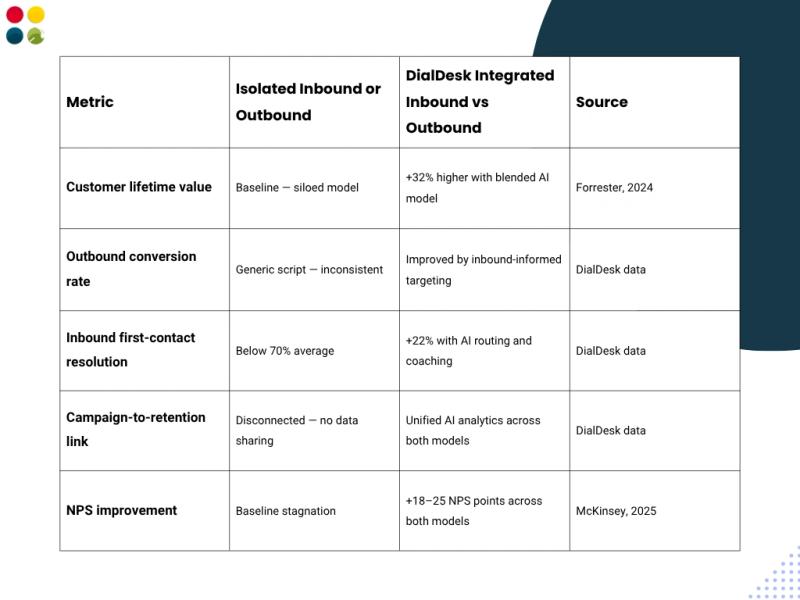
Businesses that integrate AI-powered Inbound vs Outbound Call Center Services in a blended model report 32% higher customer lifetime value compared to those operating each model in isolation, because agent insights from inbound calls directly improve outbound targeting quality (Forrester B2C CX Study, 2024).
Five Business Scenarios: Choosing Between Inbound vs Outbound Call Center Services
Scenario 1 — Retention Is the Priority
If your primary business risk is customer churn, you need a high-quality Inbound Call Center. Retention is won or lost in the support interaction, the claim handling call, and the renewal conversation, all of which are inbound. Investing in outbound before fixing inbound retention is adding revenue to a leaking bucket.
Scenario 2 — New Customer Acquisition Is the Goal
If you are launching a new product, entering a new market, or targeting a defined prospect base, an Outbound Call Center drives initial conversion. AI-powered predictive dialling, lead scoring, and real-time script guidance maximise the conversion rate from each outbound campaign.
Scenario 3 — Collections or Debt Recovery
Collections operations are inherently outbound; the business initiates contact to recover outstanding payments. However, successful collections also require Inbound Call Center capability for customers who call back with payment arrangements. Inbound vs Outbound Call Center Services must work in concert for compliance and recovery effectiveness.
Scenario 4 — Customer Research and Survey Campaigns
Proactive customer feedback campaigns, satisfaction surveys, and NPS follow-ups are outbound by nature. AI-powered outbound survey calling with sentiment analysis generates richer, more reliable data than passive post-call surveys, and at a fraction of the wait time.
Scenario 5 — Full-Cycle Customer Relationship Management
For businesses managing the complete customer lifecycle: acquisition, onboarding, support, and retention, a blended Inbound vs Outbound Call Center Services model is the only complete solution. DialDesk’s platform handles both models with unified AI analytics, ensuring that insights from inbound interactions improve outbound effectiveness and vice versa.
Business Impact: The Numbers Behind Integrated Inbound vs Outbound Call Center Services
✅ Trusted by 500+ Contact Centers Across India
DialDesk’s blended Inbound vs Outbound Call Center Services platform is ISO 9001:2015 and ISO 27001:2013 certified — enterprise-grade AI capability across both call center models, from a single unified platform. See our full call center software India platform.
Key Takeaways
• Inbound vs Outbound Call Centers is not a binary choice; both models serve distinct business objectives, and most businesses benefit from both, connected with shared AI analytics.
• Inbound Call Centers receive customer-initiated contacts; Outbound Call Centers initiate contact. Each is measured differently: resolution and CSAT for inbound, conversion and revenue for outbound.
• Businesses integrating AI-powered Inbound vs Outbound Call Center Services in a blended model report 32% higher customer lifetime value than those operating each in isolation.
• Five business scenarios- retention priority, new customer acquisition, collections, survey campaigns, and full-cycle CRM- each point to a different optimal combination of Inbound vs Outbound Call Center Services.
• DialDesk’s unified platform delivers AI-powered Inbound vs Outbound Call Center capabilities in a single system, ensuring data from each model improves the other.
Conclusion
The Inbound vs Outbound Call Center debate is not a question of which model is superior. It is a question of which model, or which combination of Inbound vs Outbound Call Center Services, best serves your business objectives at the current stage of your customer relationship strategy.
The businesses winning on both acquisition and retention in 2025 are those that have stopped treating inbound and outbound as separate operations. They are using unified AI analytics to connect the insights from both, letting inbound CX data sharpen outbound targeting, and letting outbound campaign intelligence inform inbound support preparation.
Explore how DialDesk’s integrated Inbound vs Outbound Call Center Services platform connects with your IVR and call routing, cloud telephony India stack, and AI sentiment analysis tools to build a blended operation where both models make each other better.
Inbound vs Outbound Call Center is not a choice. Done right, it is both, and DialDesk builds the platform that makes both work together.
📅 Want to Build a Blended Inbound vs Outbound Call Center Operation?
DialDesk’s AI-powered platform delivers unified Inbound vs Outbound Call Center Services from a single system, with shared analytics, dynamic agent allocation, and real-time AI across both models. Join 500+ contact centers across India already operating blended CX with DialDesk.