How Do You Tackle Stress in an Inbound Call Center?
Stress in an Inbound Call Center is the cumulative physical and psychological burden placed on agents by high call volumes, emotional labour, strict performance KPIs, and limited control over their work environment. Left unaddressed, call center stress drives agent burnout, reduces service quality, and accelerates turnover — which in India’s Inbound Call Center industry runs at 30–45% annually (Deloitte). The most effective stress management strategies combine smart Inbound Call Center Software that reduces workload through automation, structured wellness programmes, resilience training, and a team culture that treats agent wellbeing as a business performance metric, not an HR afterthought.
Why Inbound Call Center Stress Is a Business Performance Issue — Not Just an HR Concern
Inbound Call Center stress is often discussed as a welfare issue. The data makes it a business issue. Agent turnover in the call center industry runs at 30–45% annually (Deloitte). Every agent who burns out and leaves takes product knowledge, customer relationship history, and institutional experience with them, and costs the business 50–200% of their annual salary to replace (SHRM, 2024).
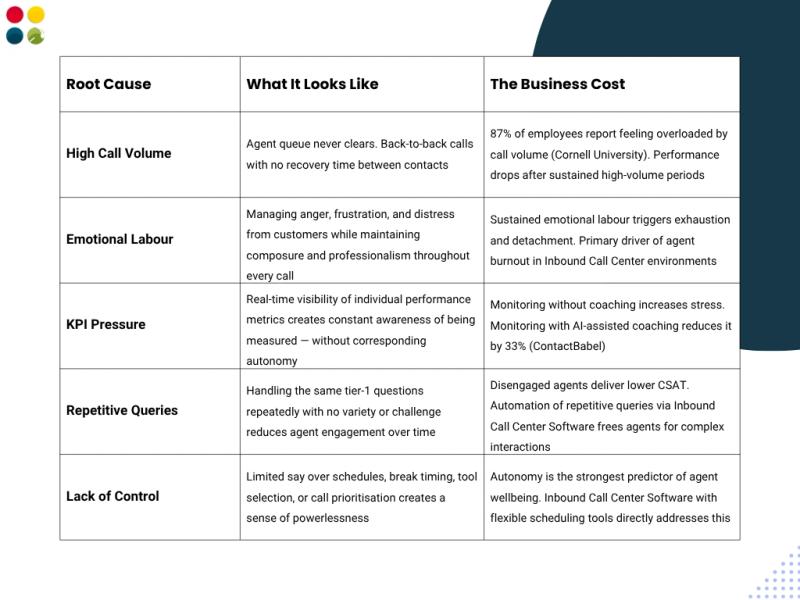
87% of call center employees report experiencing excessive call volume (Cornell University). The volume itself is rarely the root cause of stress; it is the combination of volume, insufficient tools, absence of autonomy, and emotional labour that compounds into burnout. Inbound Call Center Software that automates tier-1 queries, provides real-time agent guidance, and surfaces performance insights gives agents the control and support they need to sustain performance under pressure.
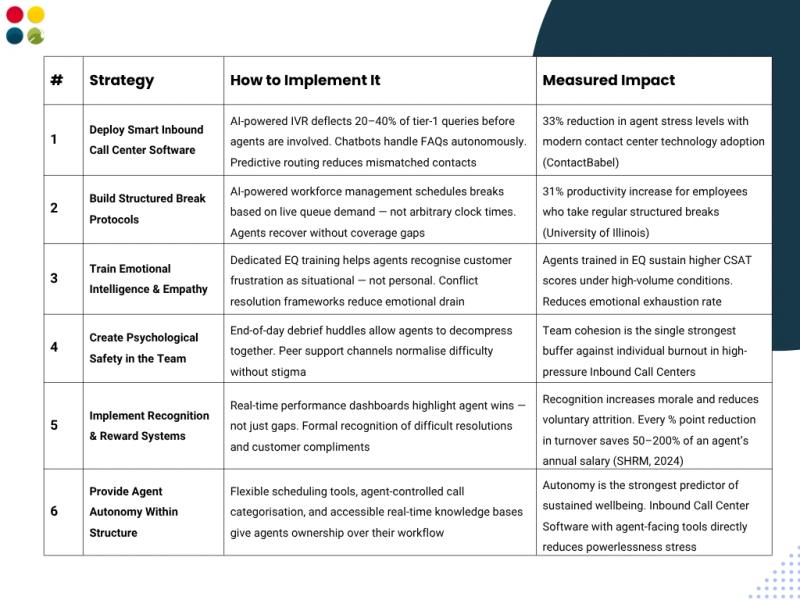
Organisations that adopt modern Inbound Call Center Software technologies experience a 33% reduction in agent stress levels (ContactBabel). The technology investment is not separate from the stress management strategy; it is a core component of it.
💡 Why It Matters
Employees who take regular breaks are 31% more productive than those who do not (University of Illinois). Inbound Call Centres that build structured break protocols into their scheduling models — supported by AI-powered demand forecasting — protect both agent well-being and operational continuity.
The 5 Root Causes of Stress in Inbound Call Centers
6 Proven Strategies to Tackle Inbound Call Center Stress
✅ Trusted by 500+ Contact Centers Across India
DialDesk’s Inbound Call Center Software automates tier-1 queries, provides real-time AI coaching, and surfaces live performance dashboards that give agents context and control — the two most effective structural defences against call center stress. ISO 9001:2015 and ISO 27001:2013 certified. Trusted by 500+ contact centers across India.
Key Takeaways
• Inbound Call Center stress drives agent turnover at 30–45% annually (Deloitte), making stress management a direct revenue and quality issue, not just an HR concern.
• The five root causes of call center stress are: high call volume, emotional labour, KPI pressure, repetitive queries, and lack of agent autonomy.
• Organisations adopting modern Inbound Call Center Software experience a 33% reduction in agent stress levels (ContactBabel), technology investment is a core stress management strategy.
• Structured break protocols increase agent productivity by 31% (University of Illinois). AI-powered workforce management enables breaks without coverage gaps.
• Emotional intelligence training, team debrief huddles, and recognition systems are the highest-impact non-technology stress management strategies.
• DialDesk’s Inbound Call Center Software automates tier-1 queries, provides real-time AI coaching, and gives agents control tools, addressing three of the five root causes of call center stress from day one.
Conclusion
Stress in an Inbound Call Center is not an inevitable feature of the job. It is a manageable variable, one that responds directly to the quality of the technology agents use, the structure of their schedule, the culture of their team, and the recognition they receive for their work.
The most effective stress management strategy is not a single programme or a wellness initiative. It is the combination of Inbound Call Center Software that removes unnecessary workload, AI coaching that gives agents guidance under pressure, and a people culture that treats wellbeing as a performance metric, because it is.
Explore how DialDesk’s Inbound Call Center platform reduces the five root causes of agent stress with AI automation, real-time coaching, flexible scheduling, and 100% call quality monitoring, all from a single cloud deployment, live in 48–72 hours.
Less stress. Better performance. Stronger retention. DialDesk builds all three.
📅 Want to Reduce Stress in Your Inbound Call Center?
DialDesk’s Inbound Call Center Software reduces agent workload through AI automation, provides real-time coaching support, and enables flexible scheduling — addressing the three primary structural causes of call center stress. PAY AS YOU USE. 48–72 hours to live.
Join 500+ contact centers across India already running lower-stress, higher-performing Inbound Call Center operations with DialDesk.