How Does Customer Service with AI Work?
Customer Service with AI means deploying artificial intelligence — including NLP virtual agents, real-time sentiment analysis, predictive routing, and automated QA scoring — to automate Tier 1 interactions, assist agents during live calls, and surface emotional signals before customers disengage. AI Customer Service platforms reduce cost per interaction by 30–40%, improve First-Call Resolution by 22%, and enable 24/7 support across voice, chat, and WhatsApp without proportional headcount growth.
Why Improving Customer Service with AI Is the 2025 CX Priority?
Speed is no longer the primary differentiator in customer experience. In 2025, the gap between leading and lagging contact centers is emotional intelligence at scale — the ability to understand not just what customers are asking, but how they feel when they ask it, and routing the right response before frustration becomes churn.
Customer Service with AI is the mechanism that makes this possible. It does not replace the human empathy that resolves a genuinely distressed customer. It ensures that empathy is directed precisely at the interactions where it is needed — rather than spread thinly across a queue that includes 60% automatable queries.
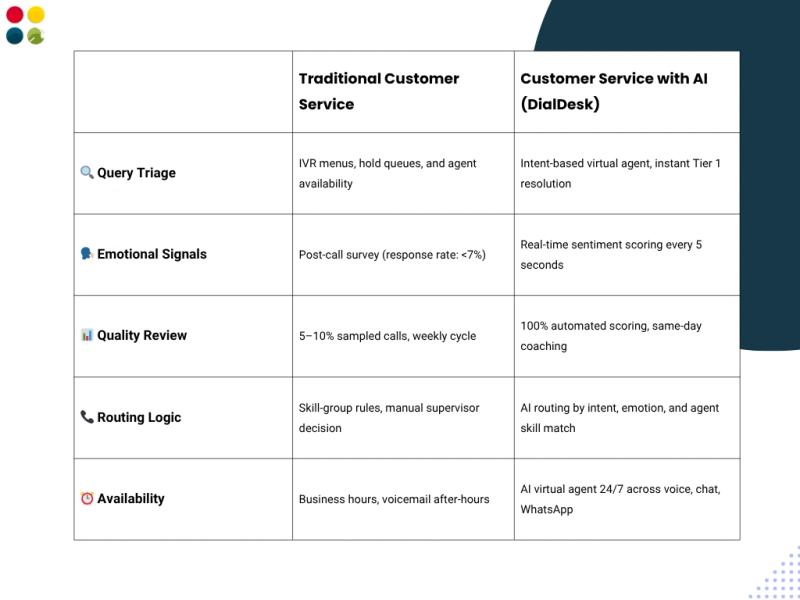
Contact centers still relying on manual scheduling, keyword-based IVR, and sampled QA are not just behind on technology. They are structurally disadvantaged on the metrics that determine customer retention: FCR, CSAT, churn prevention, and cost per resolution.
💡 Why It Matters
Only 33% of customers rate their most recent support experience as effortless (Forrester, 2024). AI for Customer Service reduces customer effort at every touchpoint — from instant Tier 1 resolution to proactive escalation based on real-time emotional signals — turning each interaction into a retention opportunity.
Customer Service with AI vs. Traditional Approaches: What Changes
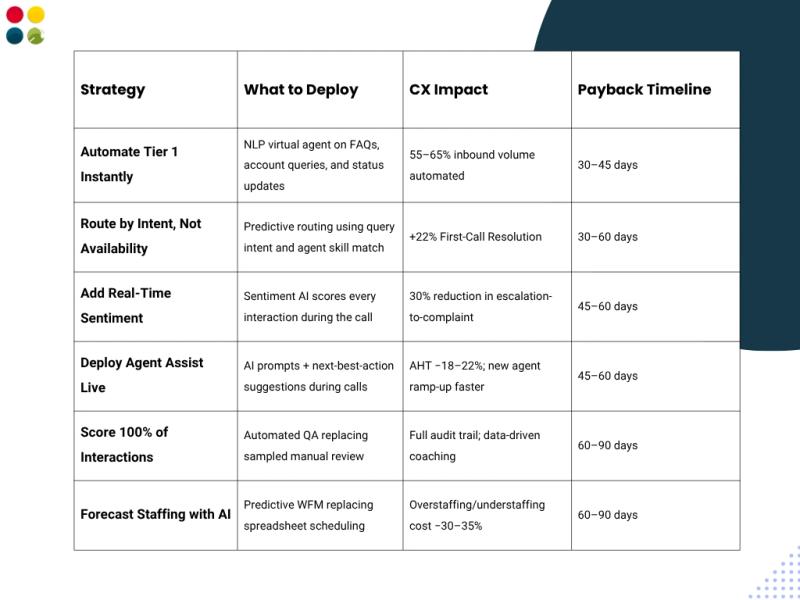
6 Practical Strategies to Improve Customer Service with AI in 2025
The most effective AI Customer Service deployments are not single-tool implementations. They are sequenced strategies that build on each other. Here are the six highest-impact approaches, ordered by speed of ROI:
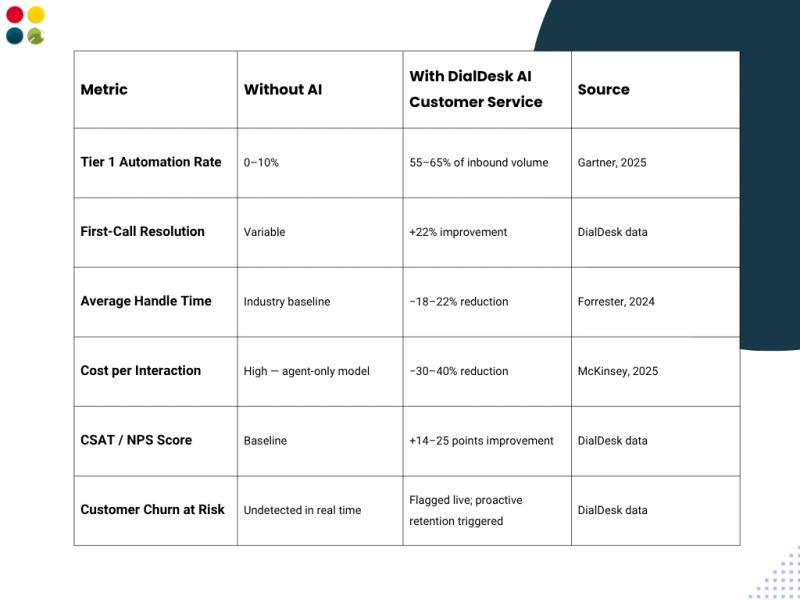
Business Impact: Measurable Results from AI for Customer Service
Contact centers that deploy Customer Service with AI as an integrated strategy — not a collection of disconnected tools — achieve compounding performance improvements (McKinsey, 2025):
✅ Trusted by 500+ Contact Centers Across India
DialDesk’s Customer Service with AI platform is ISO 9001:2015 and ISO 27001:2013 certified — enterprise-grade intelligence built and proven across India’s most demanding contact center environments, from BFSI to healthcare to e-commerce.
Key Takeaways
• Customer Service with AI is the 2025 CX baseline — not a competitive edge — for contact centers competing on retention and cost.
• AI Customer Service deployments succeed when sequenced: virtual agent and routing first, sentiment and QA second, WFM third.
• AI for Customer Service enables real-time emotional intelligence — detecting churn risk during live interactions, not after post-call surveys.
• Tier 1 automation rates of 55–65% and cost-per-interaction reductions of 30–40% are achievable within 90 days of full deployment.
• DialDesk scores 100% of interactions — not a 5–10% QA sample — across voice, chat, WhatsApp, and email in real time.
Conclusion
Customer Service with AI is not a transformation project reserved for enterprise budgets and 18-month roadmaps. It is a sequenced deployment of proven tools — each delivering measurable ROI within 30 to 90 days — that compounds in value as the AI learns from your specific interaction data.
The contact centers winning on CX in 2025 are not the ones with the largest teams. They are the ones where AI Customer Service handles what is automatable, routes what is complex, and alerts agents to what is emotionally urgent — before a customer decides to leave.
Explore how DialDesk’s AI for Customer Service platform connects with your IVR and call routing and cloud telephony India stack to deliver practical, measurable CX improvement from day one — across voice, chat, and WhatsApp, with no hardware required.
Better CX starts with smarter AI. Smarter AI starts with DialDesk.
📅 Need to Improve Customer Service with AI?
DialDesk’s AI Customer Service platform covers virtual agent, sentiment analysis, predictive routing, agent assist, and automated QA — across voice, chat, and WhatsApp from a single integration.
Join 500+ contact centers across India already transforming CX with DialDesk.