OVERVIEW
● IVR trees are interactive menus that automate the routing of calls, commonly tailoring choices based on customer data or history, to ensure effective issue resolution.
● The blog discusses how cloud telephony augments IVR trees, providing 24/7 service, multilingual capabilities, and omnichannel experiences (phone, chat, WhatsApp, email).
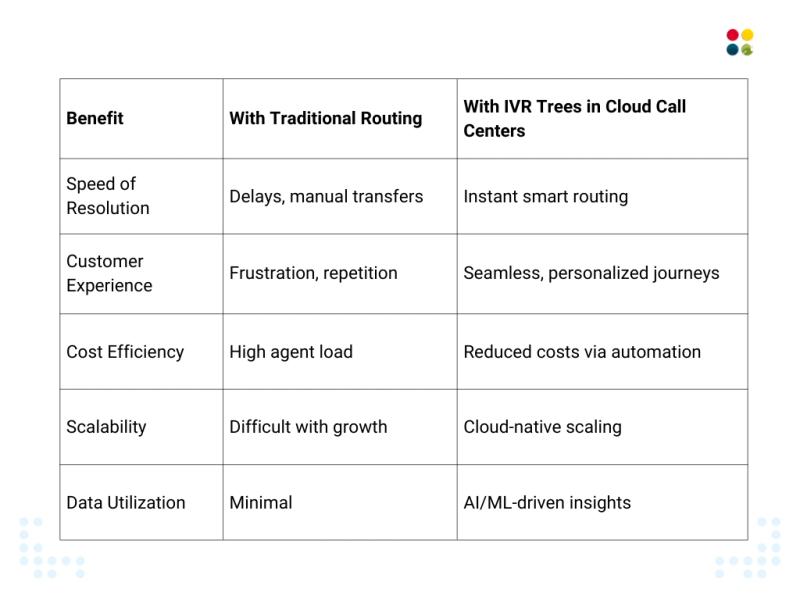
● It contrasts IVR-powered routing with conventional manual routing, highlighting gains in speed, customer satisfaction, operational expense, scalability, and data-driven insights with AI and ML.
Introduction
If there’s one moment during a customer’s journey that characterizes loyalty, it’s the initial few seconds of their call. How a business navigates call routing is usually the difference between a satisfied customer and a lost customer.
We’ve all been on calls where you’re bounced between departments, waiting endlessly to reach the “right” agent. That frustration isn’t just anecdotal—it’s a measurable business problem. A 2024 Zendesk report shows that 61% of customers stop doing business with a brand after one poor service experience.
This is where IVR trees, supported by Cloud Call Center Software, come in—not as a routing application, but as a CX growth driver. Rather than a disorienting labyrinth, a thoughtful IVR tree is more akin to a GPS for customer inquiries, with calls that go to the right spot, at the right time, with the least amount of friction.
Let’s explore how companies can reinvent their call centers with Cloud Telephony + IVR trees for intelligent routing and more robust relationships.
What are IVR Trees in Simple Terms?
Imagine an IVR tree as a decision map.
● Customers call → IVR welcomes them → They select from menu choices → System routes to optimal-fit agent/department.
● IVR Call trees are dynamic, data-based, and even have the ability to change based on customer history.
Example:
● Press 1 → Sales → Product knowledgeable agent.
● Press 2 → Technical Support → Troubleshooting agent.
● Press 3 → Billing → Finance desk.
Why IVR Trees Matter in Call Center Routing?
1. Speed = Satisfaction
Nobody enjoys waiting. Salesforce says 78% of customers assume problems will be fixed on the first contact. IVR trees allow this to happen by routing to the correct agent immediately.
2. Lower Operational Costs
By deflecting FAQs to IVR automated responses, call centers save on live-agent dependence, resulting in major cost savings.
3. Scalability with Cloud Telephony
Regardless of whether you receive 100 or 10,000 calls, Cloud Call Center Software makes sure that your IVR tree scales effortlessly.
4. Personalization at Scale
Intelligent IVR systems, supported by cloud calling services, can welcome customers personally, recognize account information, and prioritize high-value customers.
How Cloud Call Centers Use IVR Trees?
Here’s how Cloud Telephony grants IVR trees superpowers:
● Data-driven routing: Route customers to agents who resolved similar problems previously.
● 24/7 availability: Automated IVR provides 24/7 service, even when agents are not available.
● Multi-language support: Essential in diverse regions—customers get support in their preferred language.
● Omnichannel integration: Calls, chats, WhatsApp, and email can all be integrated under one IVR ecosystem.
IVR Routing Benefits at a Glance
Expert Insights & Data
● Gartner estimates that by 2026, 75% of customer service interactions will start with AI or IVR automation (Source: Gartner, 2024).
● ContactBabel states IVR containment can lower call center cost by up to 25% (Source: ContactBabel, 2024).
● Cloud Telephony adoption for call centers has increased 31% year over year, reflecting the move towards smarter routing systems (Source: Deloitte, 2024).
Expert Opinion: “IVR trees aren’t just about routing calls—they’re about routing trust. A Cloud Call Center powered by IVR ensures that every customer feels heard and valued, even before they speak to a human.” – CX Analyst, DialDesk
Thoughts to Ponder
● If your IVR Call Center still uses manual routing, how many days’ worth of customer patience are you wasting on a daily basis?
● Are you handling IVR trees as mere “menus” or as tactical CX investments?
● What would your NPS be if all customers were actually routed through correctly the first time?
Wrap Up
An IVR tree is no longer just a “voice menu.” In today’s Cloud Call Center ecosystem, it’s the engine of efficient routing, customer satisfaction, and operational scalability.
Whether you’re a startup scaling fast or an enterprise managing millions of queries, IVR trees powered by cloud calling services ensure that no call is wasted, no customer left behind.
Key Takeaways
● IVR trees are decision maps that route calls intelligently.
● Cloud Call Center Software renders IVR trees more intelligent and data-driven.
● Advantages are quicker resolutions, lower costs, personalization, and scalability.
● IVR tree users experience improved CSAT scores and fewer churns.
Conclusion
The future of call centers lies at the intersection of Cloud Telephony and IVR Tracking innovation. Businesses that invest in wiser routing today will own the customer loyalty of tomorrow.
Ready to shift your call center to intelligent IVR and Cloud Telephony solutions?
At DialDesk, we assist companies in growing with collaborative, smart, and affordable CX solutions.
Call us today—let’s create an IVR tree that prioritizes your customers.