How Can AI Help Customer Service?
How Can AI Help Customer Service? AI helps customer service by automating routine queries 24/7, routing interactions to the right agent based on intent and history, detecting customer sentiment in real time, assisting agents with live coaching, auditing 100% of interactions automatically, personalising every response from interaction data, and proactively contacting at-risk customers before they churn. DialDesk's AI Customer Service platform delivers all seven across voice, chat, and WhatsApp from a single managed platform.
Why Traditional Customer Service Breaks at Scale?
73% of customers say experience drives their buying decisions — yet only 49% feel brands consistently deliver it (PwC, 2024). This 24-point gap is not a people problem. It is a scale problem. The real question is not whether to adopt AI Customer Service — it is which capabilities to deploy first and how to measure their impact.
💡 Why It Matters
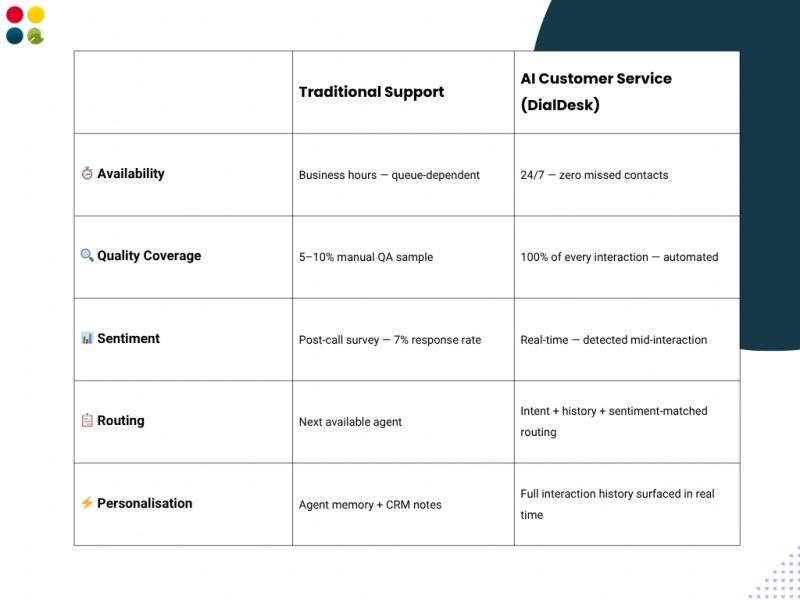
Less than 7% of customers complete post-call surveys (Qualtrics, 2024). For most brands, real-time AI is the only reliable emotional feedback channel available at scale.
Traditional vs AI Customer Service: The Core Difference
7 Proven Ways AI Helps Customer Service
1. 24/7 Automated Query Resolution
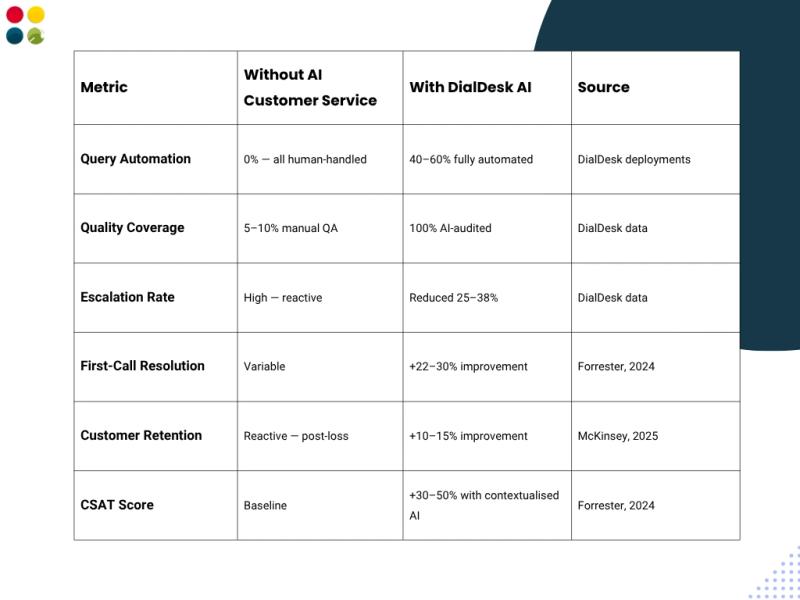
How Can AI Help Customer Service round the clock? AI voice bots and WhatsApp chatbots handle routine queries — order tracking, account checks, FAQs, and authentication — at any hour, without queue wait times. DialDesk clients see 40–60% of interactions fully automated within 30 days of deployment.
2. Intelligent Intent-Based Routing
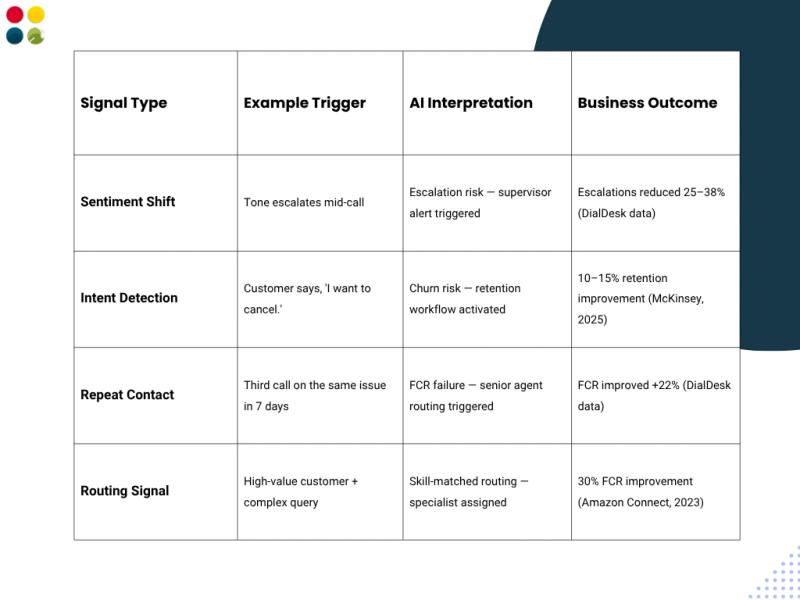
AI Customer Service routing scores every incoming interaction for intent, customer history, and agent capability — matching each query to the person most likely to resolve it first time. Amazon Connect's predictive routing delivers 30% FCR improvement (2023). DialDesk clients see measurable FCR gains within the first 30 days.
3. Real-Time Sentiment Detection
How can AI Help Customer Service with emotional intelligence? Real-time sentiment monitoring covers 100% of active interactions — reading tone, pacing, and language to detect frustration before it peaks. DialDesk's live sentiment engine reduces escalation rates by 25–38% in documented deployments.
4. Live Agent Assist
AI Customer Service delivers real-time coaching prompts, next-best-action suggestions, and compliance reminders to agents during live calls — reducing average handling time and improving resolution accuracy without additional training overhead.
5. 100% Automated Quality Assurance
AI call center automation via DialDesk's CallMaster reviews every interaction — every call, every WhatsApp thread, every chat — every agent, every shift. The result: objective quality data across 100% of operations, not a biased 5–10% manual sample.
6. Interaction-History Personalisation
How can AI Help Customer Service personalise every contact? AI surfaces the complete customer profile before the agent opens the conversation — every past interaction, purchase history, and sentiment trend. Customers never repeat themselves. Forrester (2024) documents 30–50% CSAT improvement with AI-enabled contextualised service.
7. Predictive Proactive Support
AI Customer Service identifies customers showing churn signals and triggers proactive outreach before they call. McKinsey (2025) documents 10–15% retention improvement with proactive AI intervention.
The Four Signals AI Monitors in Real Time
Business Impact: What the Numbers Show
Brands deploying AI Customer Service with the right implementation approach achieve compounding results (McKinsey, 2025):
✅ Trusted by 500+ Contact Centers Across India
DialDesk's AI Customer Service platform — including CallMaster AI and real-time sentiment monitoring — is ISO 9001:2015 and ISO 27001:2013 certified. Enterprise-grade intelligence built for India's contact center environment. See our full call center software India platform.
Key Takeaways
• How Can AI Help Customer Service — in 7 proven ways: automation, routing, sentiment, agent assist, QA, personalisation, and proactive support.
• AI Customer Service closes the 24% consistency gap that manual operations cannot address at scale (PwC, 2024).
• Real-time sentiment detection covers 100% of interactions — versus the 7% post-call survey response rate that traditional QA relies on.
• Automated QA reviews every agent, every call, every shift — eliminating the coaching blind spot created by 5–10% manual sampling.
• Predictive AI identifies churn signals and triggers proactive outreach — delivering 10–15% retention improvement (McKinsey, 2025).
• DialDesk delivers all seven capabilities on a single managed platform — across voice, WhatsApp, chat, and email.
Conclusion
How Can AI Help Customer Service? It closes every gap that scale creates — availability, quality coverage, emotional intelligence, personalisation, and proactive retention.
The brands winning on CX in 2025 are not the ones with the most agents. They are the ones that have deployed AI Customer Service intelligently — automating what AI does best, and keeping humans where empathy and judgment are irreplaceable.
Explore how DialDesk's platform connects with your IVR and call routing and cloud telephony India stack — delivering AI intelligence across every interaction from day one, no hardware required.
AI drives capability. Humans drive connection. DialDesk delivers both.
✅ Trusted Signal: DialDesk's Certifications
ISO 9001:2015 (Quality Management) · ISO 27001:2013 (Information Security) · 500+ contact centers across India · Deployed across Healthcare, Banking, Retail, Telecom, and FMCG verticals.
📅 Want to See How AI Helps Your Customer Service?
DialDesk's AI Customer Service platform automates queries, routes intelligently, detects sentiment in real time, and audits 100% of interactions — giving your team the intelligence to deliver consistent, exceptional CX at scale. Join 500+ contact centers across India already transforming support with DialDesk.