How Can AI Be Used to Improve Customer Service?
AI can be used to improve customer service through 10 distinct applications: tier-1 query automation, predictive routing, real-time sentiment monitoring, agent assist, 100% automated QA, interaction-history personalization, proactive customer care, omnichannel continuity, voice-to-text intelligence, and fraud detection, each targeting a specific operational gap in traditional support.
Why AI Customer Service Has Become Operationally Necessary?
Customer service was already under pressure before AI became accessible. Rising query volumes, multichannel expectations, staffing constraints, and the impossibility of maintaining consistency across thousands of daily interactions were problems that traditional support models managed, but never fully solved.
AI Customer Service does not solve these problems by adding more people. It solves them by changing what each person needs to do, handling the predictable so humans can focus on the meaningful, monitoring what humans cannot monitor at scale, and improving continuously from data that manual operations would never have time to analyze.
The result is not just faster service. It is fundamentally better AI customer care: more personal, more consistent, more emotionally intelligent, and more proactive than anything achievable through manual operations at the same cost.
The Business Case:
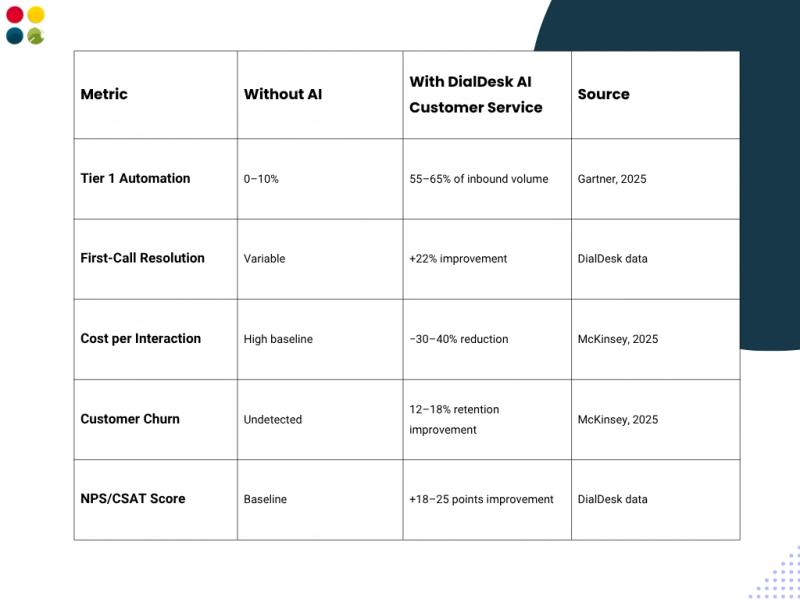
Brands using AI customer service report: 40–60% query automation, 26%+ faster resolution, 25–38% escalation reduction, 30–50% CSAT improvement, 12–18% cost reduction (McKinsey, 2025; Forrester, 2024; Deloitte, 2024). These are not projections — they are documented outcomes across retail, BFSI, and D2C deployments.
10 Proven Ways AI Is Used to Improve Customer Service
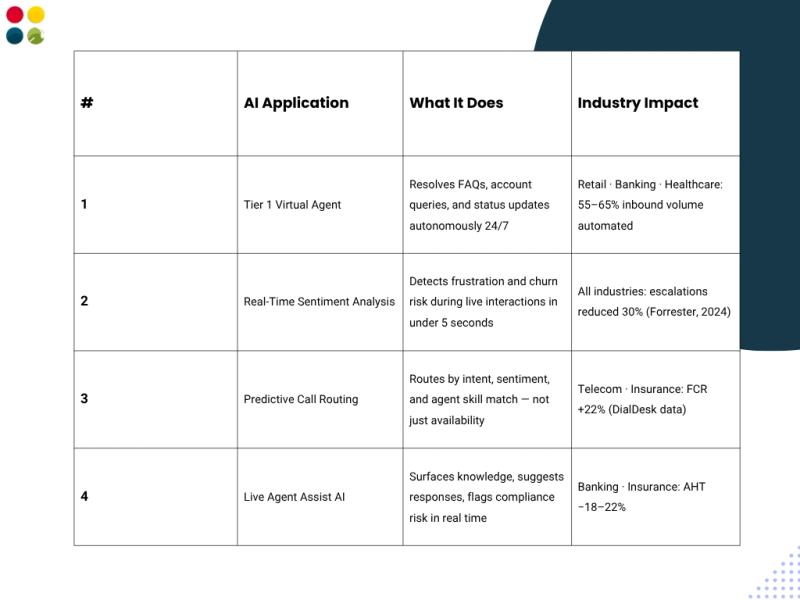
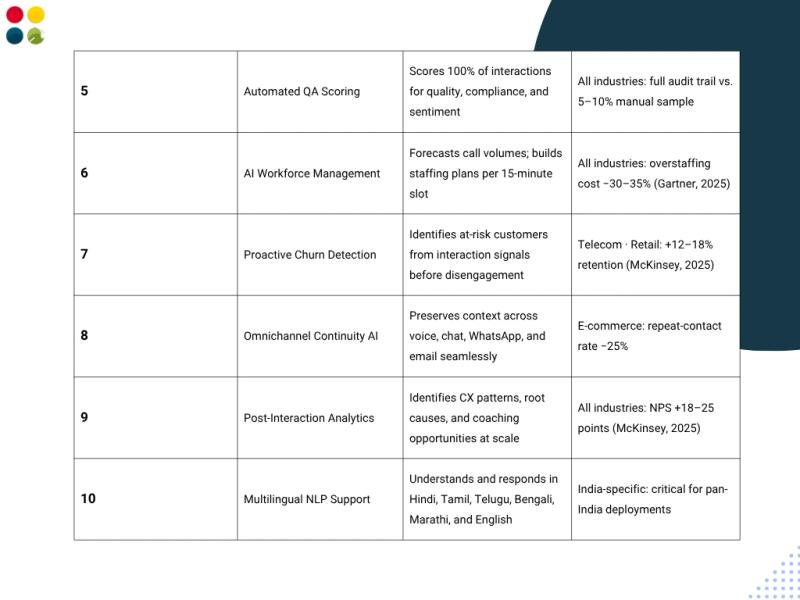
Each application below is mapped to its specific AI mechanism, the measurable outcome it produces, and the industry where its impact is highest. This is the complete use-case framework, not a list of possibilities, but a map of proven operational interventions.

✅ The AI customer service capabilities used by Amazon, HDFC Bank, and Vodafone are available to Indian businesses through DialDesk — without enterprise pricing or internal IT teams. ISO 9001:2015 + ISO 27001:2013 certified. 500+ contact centres. Go-live under 5 days.
Deep Dive: The 4 Highest-Impact AI Customer Service Applications
1. Sentiment Monitoring — The Application That Saves Relationships
Of all 10 AI customer service applications, real-time sentiment monitoring has the most direct impact on customer care quality. It is the one that speaks closest to how customers actually feel during an interaction.
Every interaction carries emotional signals. Tone shifts, changes in pacing, and certain phrases. These are the small signs that a customer is moving from patience to frustration, and sometimes to the verge of escalation. Human supervisors simply cannot track this across thousands of conversations happening at the same time. AI can. And when it picks up on these signals, it alerts the right person in real time so action can be taken before things go wrong.
The result at an operational level is a 25 to 38% reduction in escalation rates. More importantly, the customer experience changes. Instead of leaving the conversation feeling ignored, customers feel heard, understood, and recovered.
2. Agent Assist — The Application That Changes What Agents Do
Agent Assist is the AI customer service application with the most direct impact on the agent experience. Mid-call, AI surfaces the most relevant knowledge article, the most appropriate response suggestion, and critical empathy prompts when sentiment signals indicate a customer in distress.
Agents stop spending time searching and start spending time with their customers. Every conversation benefits from the organization's full knowledge base, which is instantly accessible. The documented result: 26%+ faster issue resolution, lower cognitive load, and consistently higher quality scores across the team (American Express, 2023).
3. 100% Automated QA — The Application That Eliminates Blind Spots
Traditional QA sampling reviews 5–10% of interactions. The other 90–95% are invisible — including the systemic issues that only become visible across the full data set. AI automated QA, via DialDesk's CallMaster, reviews every interaction: every call, every chat, every WhatsApp thread. It generates a summary, quality score, compliance flag, and coaching recommendation automatically, for every agent, every shift.
The coaching data this produces transforms how support teams improve. Instead of telling an agent their CSAT score went down last week, a manager can show them the exact moment in a specific call where a tone mismatch occurred and why it matters.
4. Proactive AI Customer Care — The Application That Prevents the Call
The most powerful AI Customer Care application is the one that prevents customers from needing to call at all. Predictive outreach AI identifies customers showing churn signals — declining sentiment trend, unresolved repeat contacts, post-complaint silence — and triggers outreach before the customer disengages.
For a telecom brand, this means contacting a customer about a billing anomaly before they call angrily about it. For a D2C brand, it means sending a proactive delivery update before the customer messages 'Where is my order?' for the third time. The operational cost is minimal. The loyalty impact is significant.
See Every AI Customer Service Use Case Live In Your Industry
DialDesk maps all 10 applications to your specific business: your channels, your query types, and your team. Free personalized walkthrough.
▶ Get a Free Use-Case Walkthrough → dialdesk.in
The AI + Human Model: Why AI Customer Care Requires Both
The most important thing to understand about AI customer service is what it is not designed to do alone. Full automation — without human agents — consistently underperforms the AI + human model across every metric that matters in AI customer care.
Here is why, and how the partnership works:

AI customer care is not about removing humans from the conversation. It is about ensuring that when a human is in the conversation, they are fully equipped to deliver the kind of service that no machine can replicate: genuine empathy, contextual judgment, and the trust that comes from being heard.
AI Customer Service by Industry: Where Each Application Delivers Most
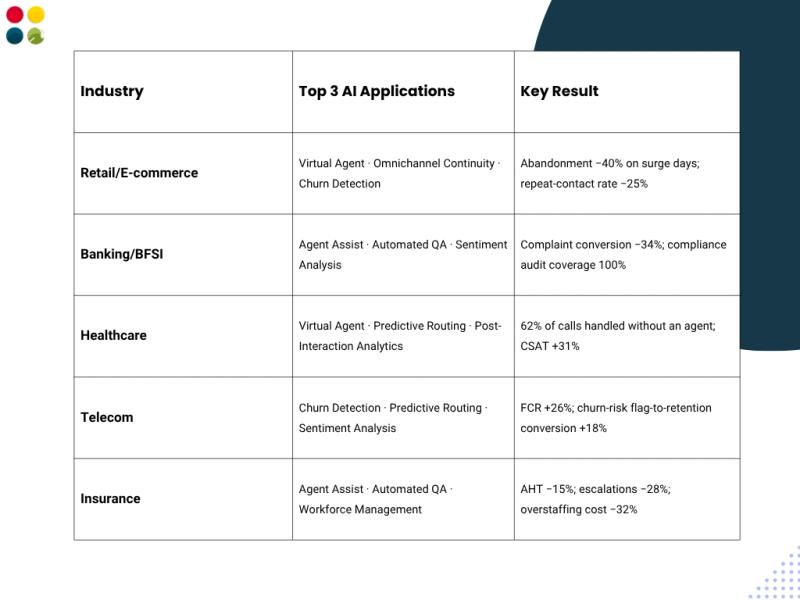
The applications of AI customer service vary significantly by industry, driven by query type, channel preference, compliance requirements, and customer base characteristics.
Here is how AI customer support and care map across DialDesk's core industry verticals:

✅ A retail brand using DialDesk: 40% faster response times, 30% fewer missed calls, NPS improvement through sentiment-based coaching within 90 days. Zero additional agents. CallMaster covering 100% of interactions from day one.
Implementation Challenges and How to Avoid Them
Challenge 1: Over-Automating Without Human Fallback
The most common AI customer service implementation failure is deploying automation without a clear, graceful escalation path to human agents. Customers do not object to interacting with AI; they object to feeling trapped by it. Every AI customer service deployment must have a defined escalation trigger: when AI cannot resolve with confidence, a human agent receives full context and takes over immediately.
Challenge 2: Deploying in Isolation from Existing Systems
AI customer service that does not connect to your CRM, telephony, and ticketing creates data silos that undermine the personalization advantage. The integration layer is not optional; it is what turns AI from a standalone tool into an intelligence fabric across the entire support operation.
Challenge 3: Measuring Success Only on Volume
Ticket volume reduction is one output. It is not the measure of AI customer service success. Track a balanced scorecard: FCR, AHT, CSAT, escalation rate, QA coverage %, agent satisfaction, and NPS. All of these move measurably with properly deployed AI customer care, and all of them matter more to business outcomes than the number of tickets deflected.
Key Takeaways
• AI can be used to improve customer service through 10 distinct applications, each targeting a specific operational gap, from tier-1 automation to fraud detection.
• AI customer care specifically improves the emotional quality of interactions through sentiment monitoring, personalization, agent empathy prompting, and proactive outreach.
• AI Customer Support changes operations structurally: 100% QA coverage, demand-accurate scheduling, skill-matched routing, and real-time agent assist.
• The AI + human model consistently outperforms full automation — AI handles the predictable; humans handle the emotional and complex.
• DialDesk delivers all 10 AI customer service applications in a single managed platform — built for India's multilingual, WhatsApp-first contact centre environment.
Conclusion
AI can be used to improve customer service in 10 distinct, proven, measurable ways, and each application compounds the effect of the others when deployed as part of a unified strategy rather than as isolated tools.
The brands winning in AI customer service and AI customer care in 2025 are not the ones with the most technology. They are the ones who understood which applications to deploy, in what order, and how to keep human empathy at the centre of everything AI enables.
AI customer service is not about doing more with less. It is about doing better — with the team and the technology working together.
DialDesk makes all 10 applications available in one managed platform built for India, and is live in under 5 days.
Ready to Put AI Customer Service to Work for Your Business?
All 10 applications. One managed platform. Voice, WhatsApp, chat, QA, routing, sentiment — live in under 5 days. 500+ brands. ISO certified.
▶ Book Your Free Demo → dialdesk.in/book-demo