OVERVIEW
● Every thriving business has one thing in common — customers who feel valued.
● This blog explores the core principles of Customer Service Excellence, how top-performing teams achieve it consistently, and the practical strategies that any organization can adopt.
● We’ll uncover the mindset, metrics, and systems that separate exceptional service teams from the average.
Introduction
At the heart of every great brand story is a quiet hero — the customer service team. They don’t merely fix issues; they safeguard brand trust, retain customers, and frequently determine the lifetime value of a customer long after the purchase has been made.
Customers today aren’t blown away by just speed — they expect empathy, ownership, and consistency. In a Zendesk study, 81% of customers indicate that a good support experience makes it more likely for repeat purchasing to happen, and 61% jump to a competitor after a single negative experience.
That’s not a service problem — that’s a business threat.
In markets such as India, where consumer needs change day to day, and word-of-mouth can destroy a brand overnight, Customer Service Excellence isn’t a department objective — it’s a company culture.
So what is it about a customer service team that makes them excellent? Let’s dive in and find out.
The Foundation of Customer Service Excellence
Excellent Customer Service starts long before a call or chat ever occurs. It starts with clear systems, robust training, and a common purpose.
Core Pillars:
● Empathy as Strategy: Each customer desires to be listened to before they are served. Empathy-led teams experience greater satisfaction and retention.
● Empowered Teams: Exceptional organizations trust their agents to exercise judgment — without requiring infinite approvals.
● Continuous Learning: Consumer expectations shift quickly. Coaching repeatedly reinforces that skills adapt, not merely roles.
● Tech + Human Balance: Automation accelerates tasks; people maintain relationships.
Stat Insight: Salesforce reports 88% of customers cite experience being as important as the product.
What Sets Top-Performing Teams Apart?
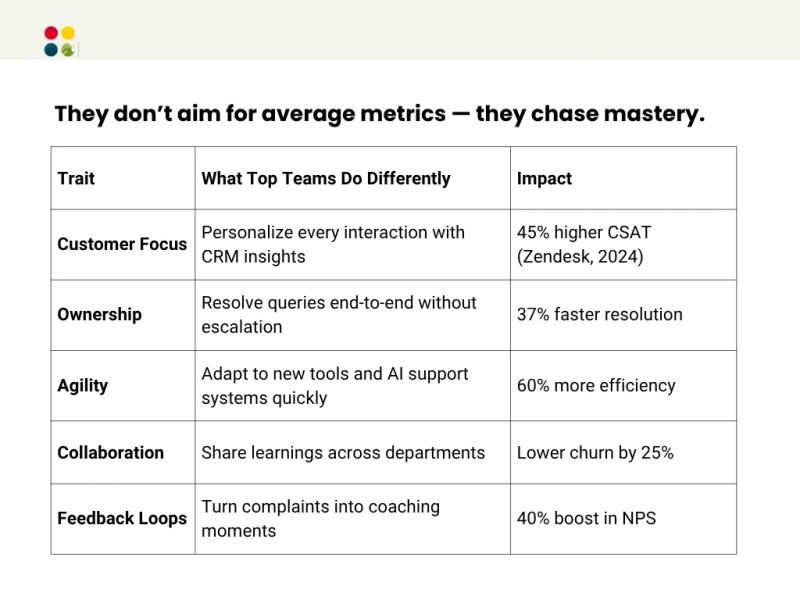
High-performing teams view every interaction as a learning experience. They don’t merely fix — they examine trends, automate routine problems, and reverse-feed insights back into business strategy.
The Human Element: Why Culture Wins Over Scripts
Service excellence is 20% tools, 80% attitude.
A team’s tone, patience, and passion may be more reflective of the internal culture than any SOP.
Great teams:
● Celebrate small wins — such as completing a difficult ticket or an email “thank you” from a customer.
● Learn from difficult calls — blame-free.
● Stay in line with brand purpose — not only process KPIs.
Real Talk: A purpose-driven team sounds different — customers can tell, even on chat text.
Metrics That Matter (Beyond Response Time)
Faster responses don’t always mean better service.
High-performance teams track what actually fuels loyalty.
Key Metrics for Customer Service Excellence:
● CSAT (Customer Satisfaction Score): Assesses post-interaction happiness.
● CES (Customer Effort Score): Asks customers how easy it was to get assistance.
● FCR (First Contact Resolution): Measures resolution efficiency — a 10% FCR boost can cause a 22% CSAT increase. (Source: MetricNet)
● NPS (Net Promoter Score): Captures long-term loyalty, rather than short-term satisfaction.
The top teams don’t pursue vanity metrics — they link these scores to actual business results such as repeat purchase, retention, and referrals.
Technology as the Silent Partner
AI and WhatsApp Business Automation are no longer “nice-to-haves.” They are co-pilots for performance.
How Top Teams Use Tech Wisely:
● AI Call Auditing & Insights (such as DialDesk’s CallMaster): Identify training gaps and sentiment patterns in an instant.
● Chatbots & Self-Service: Relieve human agents of routine issues.
● Unified Dashboards: Provide a 360° picture of customer interactions.
● Predictive Analytics: Predict churn or dissatisfaction before occurrence.
Stat Check: Gartner forecasts that by 2026, 70% of customer interactions will be AI-based solutions.
When technology enhances human judgment — not eliminates it — service excellence can be scaled.
Thoughts to Ponder
● Are your agents allowed to make decisions, or merely respond?
● Do your systems gather data or provide insights?
● Is your CX culture centered on empathy, or efficiency?
● Is your tech bringing people together — or simply automating?
The answers tend to mark the difference between good service and Customer Service Excellence.
Wrap Up
Customer Service Excellence doesn’t happen overnight — it’s crafted, one interaction at a time.
It’s not a goal; it’s a standard that teams maintain every day, with the backing of strong leadership, consistent coaching, and smart tools.
And the bonus? Excellence builds on itself. The more you put into it, the greater trust — and profits — it pays back.
Key Takeaways
● Excellent Customer Service Examples = Strategy + Culture + Data + Technology
● Empathy and ownership have the greatest impact on loyalty
● High-performing teams measure results, not activity
● AI capabilities such as DialDesk’s CallMaster inform wiser decisions
● Continuous learning sustains excellence
Conclusion
Customer Service Excellence isn’t about pursuing perfection — it’s about building repeatable, memorable moments that customers can trust and recall.
It’s where people, process, and technology come together to deliver results that drive both satisfaction and growth.
At DialDesk, we enable brands to improve service quality through AI-driven insights, omnichannel service, and actionable analytics — so every customer conversation is an experience of excellence.
Transform your customer care with DialDesk — where each touch counts.