OVERVIEW
● This article examines how businesses can efficiently process dispatch calls in order to boost productivity, reduce lost opportunities, and deliver improved customer experiences.
● We’ll break down best practices, offer real-world figures, and end with expert advice you can apply today to maximize your dispatch operations.
Introduction
In a world where every minute matters, a single dispatch call can make or break a customer experience. Whether you’re managing logistics, emergency services, home repairs, or field sales, your ability to handle that one call defines your operational reputation.
Bad news here: 69% of customers say speed of resolution is a driver of loyalty (Zendesk, 2024). Yet many businesses still rely on legacy systems, manual call transfers, or siloed tools to manage dispatch communication.
Contemporary dispatching is not just about taking calls — it’s about real-time coordination, accurate info swapping, and human empathy powered by technology. Properly executed, Dispatch Calls are your greatest link between your staff and your customers. Poorly executed, they’re your most expensive waste.
Let’s decipher the code of what “effective dispatch call handling” entails — with industry expert tips, best practices, and data points.
Why Dispatch Calls Matter More Than Ever?
Dispatch calls are mission-critical to companies like:
● Healthcare – Patient transports, emergency coordination
● Utilities – Service repairs, outage management
● Field Service – Installation, maintenance, or technician scheduling
● Logistics & Transport – Delivery status and route tracking
Stat Check: Optimizing dispatch operations can recover up to 35% of operation delays, growing first-call resolutions by 42%, according to Field Technologies Online (2025).
In brief, the faster and smarter your dispatch response, the higher your brand earns trust, time, and turnover.
Best Practices for Handling Dispatch Calls Effectively
1. Centralize Call Management
Use a centralized dispatch dashboard or CRM integration whereby calls, logs, and schedules are shared among all the concerned teams.
Why it matters: Avoids double-booking and lost updates.
Pro tip: Tools such as DialDesk bring together calls and chat in one window for improved real-time monitoring.
2. Prioritize Call Routing Efficiency
Call automation enables clients to reach the right dispatcher instantly.
● Use IVR systems for categorizing call purposes.
● Route calls by geographic location, urgency, or product or service.
Outcome: Organizations using intelligent routing achieve 27% faster resolution (HubSpot Data Trends, 2025).
3. Train Teams for Calm, Clarity, and Accuracy
Dispatchers balance the thin line — emergencies, delays, customer fury.
Invest in scenario simulation and call empathy training.
● Utilize tone scripts for urgent vs. routine cases.
● Model “listen > confirm > act” behavior.
Stat: 40% reduction in call escalations is achieved through trained dispatchers (Service Council Report, 2024).
4. Leverage Real-Time Call Analytics
Call analytics uncover:
● Average response times
● Agent performance
● Missed or abandoned calls
Insight: Use AI-powered analysis to identify trends — e.g., peak periods or recurring service issues.
Data-driven actions → Faster dispatch decisions → Smiling customers.
5. Integrate Call + Field Communication
Dispatch calls shouldn’t live in isolation.
Integrate:
● GPS or field tracking apps
● WhatsApp Business API for customer updates
● Automated callback systems
When field workers and agents share real-time data, the communication gap narrows, and task completion rate improves.
6. Document Every Interaction
Every dispatch call = data gold.
Document:
● Caller intent
● Time taken to assign
● Actions taken and follow-ups
Why: Correct call records help during audit, check performance, and training in the future.
Bonus: Insert notes straight into your CRM for smooth continuity.
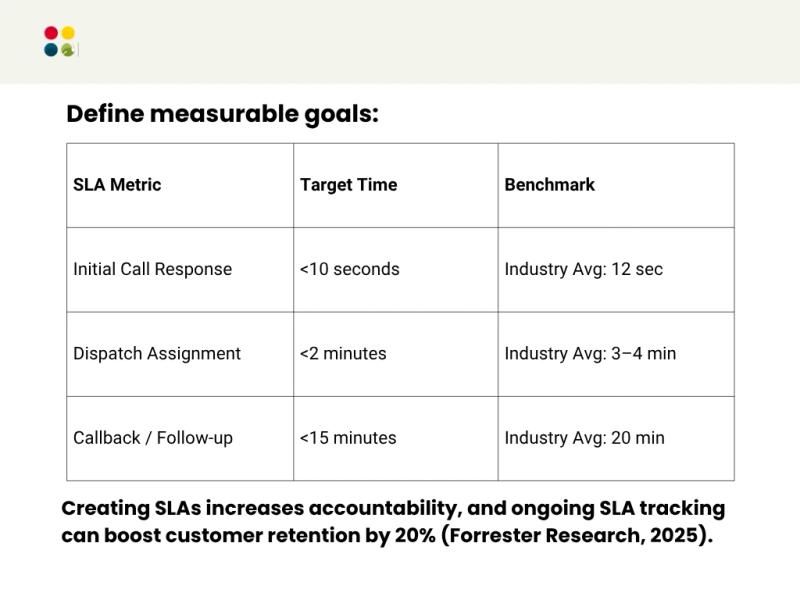
7. Set SLAs (Service Level Agreements) for Calls
8. Audit Missed Calls Regularly
Every missed call for dispatch is an opportunity lost.
● Automate callback triggers.
● Audit why calls were missed (lack of staff, network issue, conflict of times).
● Enforce retry workflows on high-priority requests.
Deployers who conduct missed call audits weekly report 18% higher dispatch speed.
9. Use AI-Powered Call Summaries
Reduce time and effort manually.
AI solutions can automatically summarize calls into structured reports:
● Caller details
● Problem description
● Next action steps
This avoids zero loss of information and faster task relaying between teams.
10. Don’t Forget the Human Touch
Behind every Call Dispatch is a human being who is anticipating help. Empathy and simplicity generate emotional trust that technology can’t match. Make every dispatcher’s mission simple: Answer quickly. Communicate clearly. Act with intent.
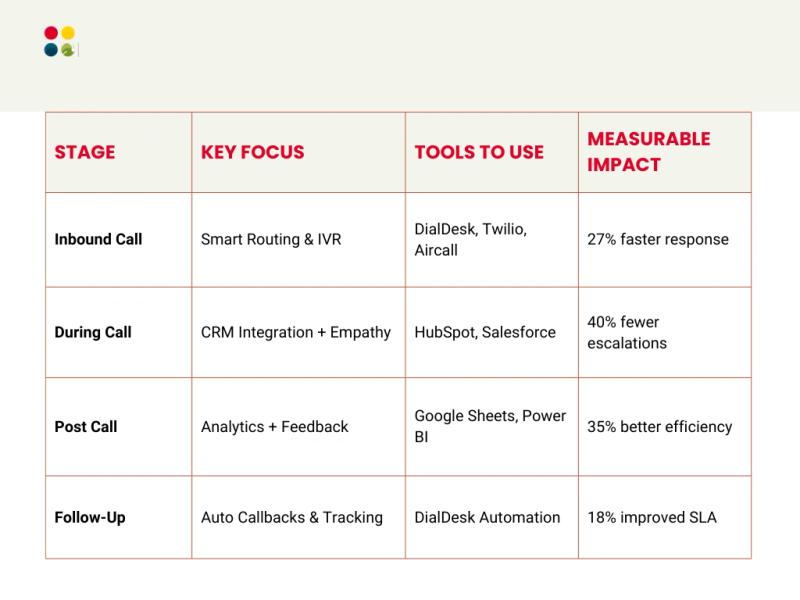
Dispatch Call Optimization Framework
Thoughts to Ponder
● Are your dispatchers responding or expecting?
● Is your call data making a real difference or simply collecting dust in logs?
● Can your team keep empathy in the face of urgency — every single time?
The companies that respond with the truth are the ones that scale sustainably.
Wrap Up
Dispatch Call Center management is not a matter of speed — it’s a matter of people, process, and technology coordination. With skilled dispatchers, real-time analytics, and empathetic communication, every call is a chance to impress.
Key Takeaways
● Centralize and automate routing of calls.
● Integrate communication between field teams and dispatchers.
● Utilize AI and analytics for performance optimization.
● Audit, document, and create SLAs religiously.
● Balance technology with empathy.
Conclusion
Dispatch calls are more than operational checkboxes — they’re a reflection of your brand’s reliability. Each second saved and every call resolved efficiently, becomes a small win that compounds over time.
If you’re looking to modernize your dispatch management, analyze call data in real time, and enhance every customer interaction, it’s time to move beyond manual systems.
DialDesk helps businesses optimize dispatch operations through intelligent call routing, analytics, and automation.
Make each call a moment of trust — with DialDesk.